M203 20260228 Trig and Complex Numbers
1. Polar form of Complex Numbers
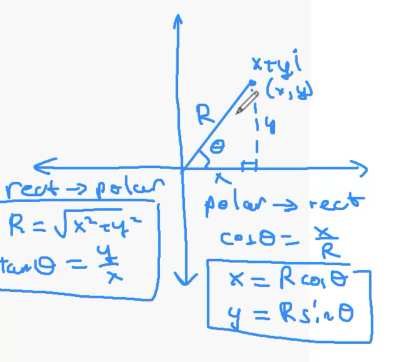
1 ) Write the following in Polar Form:
- $-6$
- $4 + 4i$
- $3 - \sqrt{3}i$
- $-\sqrt{2} + \sqrt{6}i$
Answers
- $-6 = 6 (\cos \pi + i \sin \pi) = 6e^{i\pi}$
- $4 + 4i = 4\sqrt{2} \left( \cos \dfrac{\pi}{4} + i \sin \dfrac{\pi}{4} \right) = 4\sqrt{2}e^{i\frac{\pi}{4}}$
- $3 - \sqrt{3}i = 2\sqrt{3} \left( \cos \left( -\dfrac{\pi}{6} \right) + i \sin \left( -\dfrac{\pi}{6} \right) \right) = 2\sqrt{3}e^{-i\frac{\pi}{6}}$
- $-\sqrt{2} + \sqrt{6}i = 2\sqrt{2} \left( \cos \dfrac{2\pi}{3} + i \sin \dfrac{2\pi}{3} \right) = 2\sqrt{2}e^{i\frac{2\pi}{3}}$
2 ) Let $w = 3 + \sqrt{3}i$ and $z = 2\sqrt{3} - 6i$
• Find the relationship between $w$, $z$ and $wz$ in polar form
• Find the relationship between $w$, $z$ and $\dfrac{w}{z}$ in polar form
• Let $w = R(\cos\alpha + i\sin\alpha)$, $z = S(\cos\beta + i\sin\beta)$, what is $wz$? What is $\dfrac{w}{z}$?
Answer:
$wz = RS[\cos(\alpha + \beta) + i\sin(\alpha + \beta)]$
$\dfrac{w}{z} = \dfrac{R}{S}[\cos(\alpha - \beta) + i\sin(\alpha - \beta)]$
3 ) Prove De Moivre's Theorem:
#De_Moivres_Theorem
• $\LARGE (\cos \alpha + i \sin \alpha)^n = \cos(n\alpha) + i \sin(n\alpha)$
• $\LARGE (\cos \alpha - i \sin \alpha)^n = \cos(n\alpha) - i \sin(n\alpha)$
2. Exponential Form of Complex Numbers
Euler's Theorem
#Eulers_Theorem
$\LARGE \cos\alpha + i\sin\alpha = \LARGE e^{i\alpha}$
Express in Exponential Form or Rectangular Form:
• $-\dfrac{3}{\sqrt{3}} + 3i$
• $e^{\pi i}$
#Exponential_Form #Polar_Form
| Form | Representation | Components |
|---|---|---|
| Rectangular Form | $x + yi$ | Rectangular coordinates $(x, y)$ |
| Polar Form | $R(\cos\theta + i\sin\theta)$ or $R \text{ cis } \theta$ | Polar coordinates $(R, \theta)$ |
| Exponential Form | $R e^{i\theta}$ | Magnitude $R$ and phase $\theta$ |
Express in Exponential Form or Rectangular Form:
• $\LARGE 6e^{\frac{\pi i}{3}}$
• $(1+i)^{20}$
For what value of $\alpha$ is $e^{i\alpha}=1$?
If $z = r e^{i \alpha}$, what is the conjugate of $z$?
Product of $z$ and its Conjugate
Multiplying a complex number by its conjugate results in the square of its magnitude (or modulus):
$$z \cdot \bar{z} = (r e^{i \alpha})(r e^{-i \alpha}) = r^2 e^0 = r^2$$
In rectangular form, if $z = x + yi$, this is equivalent to:
$$z \cdot \bar{z} = x^2 + y^2$$
Find $\cos\alpha$ and $\sin\alpha$ with $e^{i\alpha}$ and $e^{-i\alpha}$?
Euler's Inverse Formulas
#Eulers_Inverse_Formula
$$\cos\alpha = \frac{e^{i\alpha} + e^{-i\alpha}}{2}$$
$$\sin\alpha = \frac{e^{i\alpha} - e^{-i\alpha}}{2i}$$
an application of Euler's Inverse Formula for cosine to simplify an infinite series.
Mathematical Breakdown
The expression shows how to convert a trigonometric series into a geometric series using complex exponentials:
1. Euler’s Substitution: Using the identity $\cos(n\theta) = \frac{e^{in\theta} + e^{-in\theta}}{2}$, the term $\frac{\cos(n\theta)}{2^n}$ is rewritten.
2. Series Expansion: The summation is split into two separate parts:
$$\sum_{n=1}^{\infty} \frac{\cos(n\theta)}{2^n} = \sum_{n=1}^{\infty} \left( \frac{e^{in\theta}}{2^{n+1}} + \frac{e^{-in\theta}}{2^{n+1}} \right)$$
3. Purpose: This transformation is a common technique in competitive math (like the AMC) and calculus to evaluate infinite sums. By converting the trigonometric terms into complex exponentials, the expression becomes a sum of two geometric series, which are much easier to solve using the formula $S = \frac{a}{1-r}$.
To complete the evaluation of the series $\sum_{n=1}^{\infty} \frac{\cos(n\theta)}{2^n}$, we can sum the two resulting geometric series identified in the previous step.
Step-by-Step Evaluation
1. Identify the Geometric Series:
The expression is split into two series with the general form $\sum_{n=1}^{\infty} \frac{1}{2} \left( \frac{e^{i\theta}}{2} \right)^n$ and $\sum_{n=1}^{\infty} \frac{1}{2} \left( \frac{e^{-i\theta}}{2} \right)^n$.
2. Apply the Sum Formula:
For a geometric series $\sum_{n=1}^{\infty} ar^n$, the sum is $S = \frac{ar}{1-r}$. Here, $a = \frac{1}{2}$ and the common ratios are $r_1 = \frac{e^{i\theta}}{2}$ and $r_2 = \frac{e^{-i\theta}}{2}$.
$$S = \frac{1}{2} \left( \frac{\frac{e^{i\theta}}{2}}{1 - \frac{e^{i\theta}}{2}} + \frac{\frac{e^{-i\theta}}{2}}{1 - \frac{e^{-i\theta}}{2}} \right) = \frac{1}{2} \left( \frac{e^{i\theta}}{2 - e^{i\theta}} + \frac{e^{-i\theta}}{2 - e^{-i\theta}} \right)$$
3. Find a Common Denominator:
Combining the fractions:
$$\frac{e^{i\theta}(2 - e^{-i\theta}) + e^{-i\theta}(2 - e^{i\theta})}{(2 - e^{i\theta})(2 - e^{-i\theta})}$$
4. Simplify Using Euler's Formula:
- Numerator: $2e^{i\theta} - 1 + 2e^{-i\theta} - 1 = 2(e^{i\theta} + e^{-i\theta}) - 2$. Since $e^{i\theta} + e^{-i\theta} = 2\cos\theta$, the numerator is $4\cos\theta - 2$.
- Denominator: $4 - 2e^{-i\theta} - 2e^{i\theta} + 1 = 5 - 2(e^{i\theta} + e^{-i\theta}) = 5 - 4\cos\theta$.
5. Final Result:
Multiply by the $\frac{1}{2}$ from the start:
$$\text{Sum} = \frac{2\cos\theta - 1}{5 - 4\cos\theta}$$
3. Roots of Unity
#Roots_Of_Unity
Derivation of the Roots of $F(x) = x^n - 1$
To find the roots of $F(x) = x^n - 1$, we solve the equation $x^n = 1$, where the solutions are known as the $n^{th}$ roots of unity.
1. Exponential Representation of 1
Using Euler's Formula, the number $1$ can be expressed in the complex plane as:
$$1 = e^{i(2\pi m)}$$
where $m$ is any integer.
2. Set up the Equation
Substitute the complex form into the root equation:
$$x^n = e^{i(2\pi m)}$$
3. Solve for $x$
Take the $n^{th}$ root of both sides by raising them to the power of $1/n$:
$$x = (e^{i(2\pi m)})^{1/n}$$
$$x = e^{i\left(\frac{2\pi m}{n}\right)}$$
4. Define the Unique Roots
To obtain $n$ distinct roots, we let $m$ range from $0$ to $n-1$:
$$x_m = e^{i\left(\frac{2\pi m}{n}\right)} \quad \text{for } m = 0, 1, 2, \dots, n-1$$
5. Conversion to Polar Form
Using the identity $e^{i\theta} = \cos\theta + i\sin\theta$, the roots are:
$$x_m = \cos\left(\frac{2\pi m}{n}\right) + i\sin\left(\frac{2\pi m}{n}\right)$$
Here are the solutions for the roots of the polynomials presented in the provided images:
Solutions for Roots of $F(x) = x^n - 1$
| Polynomial | Factored Form | Roots ($x$) | Visualization |
|---|---|---|---|
| $F(x) = x^3 - 1$ | $(x-1)(x^2+x+1)$ | $1, -\frac{1}{2} \pm \frac{\sqrt{3}}{2}i$ | $3^{\text{rd}}$ roots of unity |
| $F(x) = x^4 - 1$ | $(x^2-1)(x^2+1)$ | $1, -1, i, -i$ | $4^{\text{th}}$ roots of unity |
| $F(x) = x^6 - 1$ | $(x^3-1)(x^3+1)$ | $1, -1, \frac{1}{2} \pm \frac{\sqrt{3}}{2}i, -\frac{1}{2} \pm \frac{\sqrt{3}}{2}i$ | $6^{\text{th}}$ roots of unity |
Key Formulas Used
- General Solution: For any $F(x) = x^n - 1$, the roots are given by $x = e^{i\left(\frac{2\pi m}{n}\right)}$ for $m = 0, 1, \dots, n-1$.
- Quadratic Formula: Used to find the complex roots of $x^2 + x + 1 = 0$, resulting in $x = \frac{-1 \pm i\sqrt{3}}{2}$.
Would you like me to help Elaine's son work through the more advanced problem from the worksheet, such as solving for $x^6 = -64$?
Problem: Suppose $w$ is a root of $F(z) = z^n - 1$, what of the following must also be a root of $F(z)$: $\bar{w}$, $w-1$, $1/w$?
Explanation
This problem explores the properties of the $n^{\text{th}}$ roots of unity, which are the solutions to the equation $z^n = 1$.
1. The Conjugate ($\bar{w}$)
- Property: For any polynomial with real coefficients, if a complex number is a root, its conjugate must also be a root.
- Verification: If $w = e^{i\theta}$, then $\bar{w} = e^{-i\theta}$.
- Proof: $(e^{-i\theta})^n = e^{-in\theta}$. Since $w$ is a root, $n\theta$ is a multiple of $2\pi$, making $e^{-in\theta} = 1$.
- Conclusion: $\bar{w}$ must be a root.
2. The Translation ($w-1$)
- Property: Shifting a root usually removes it from the unit circle.
- Verification: If $w=1$ (a root for any $n$), then $w-1 = 0$. Since $0^n \neq 1$, it is not a root.
- Conclusion: $w-1$ is not necessarily a root.
3. The Reciprocal ($1/w$)
- Property: Since all roots of unity have a magnitude of $|w|=1$, the reciprocal of a root is equivalent to its conjugate ($1/w = \bar{w}$).
- Verification: If $w^n = 1$, then $(1/w)^n = 1/w^n = 1/1 = 1$.
- Conclusion: $1/w$ must be a root.
Final Answer: Both $\bar{w}$ and $1/w$ must also be roots of $F(z)$.
2 ) If the six solutions of $x^6 = -64$ are written in the form $a+bi$, where $a$ and $b$ are real, then find the product of the solutions with $a>0$?
1. Represent $-64$ in Polar Form
In the complex plane, $-64$ lies on the negative real axis.
- Modulus ($R$): $64$
- Argument ($\theta$): $\pi$ (or $180^\circ$)
- General form: $-64 = 64 e^{i(\pi + 2\pi m)}$ for any integer $m$.
2. Solve for $x$
Take the $6^{\text{th}}$ root of both sides:
$$x = (64 e^{i(\pi + 2\pi m)})^{1/6}$$
$$x = 64^{1/6} \cdot e^{i\left(\frac{\pi + 2\pi m}{6}\right)}$$
Since $2^6 = 64$, the magnitude of each root is $2$:
$$x_m = 2 e^{i\left(\frac{\pi}{6} + \frac{\pi m}{3}\right)} \quad \text{for } m = 0, 1, 2, 3, 4, 5$$
3. List the Six Solutions
By plugging in $m$ and converting to $a + bi$ form ($x = 2(\cos \theta + i\sin \theta)$):
| m | Angle (θ) | Solution (a+bi) |
|---|---|---|
| 0 | $30^\circ$ | $2(\frac{\sqrt{3}}{2} + \frac{1}{2}i) = \sqrt{3} + i$ |
| 1 | $90^\circ$ | $2(0 + i) = 2i$ |
| 2 | $150^\circ$ | $2(-\frac{\sqrt{3}}{2} + \frac{1}{2}i) = -\sqrt{3} + i$ |
| 3 | $210^\circ$ | $2(-\frac{\sqrt{3}}{2} - \frac{1}{2}i) = -\sqrt{3} - i$ |
| 4 | $270^\circ$ | $2(0 - i) = -2i$ |
| 5 | $330^\circ$ | $2(\frac{\sqrt{3}}{2} - \frac{1}{2}i) = \sqrt{3} - i$ |
4. Find the Product of Solutions with $a > 0$
The question specifically asks for the product of solutions where the real part $a$ is positive. These are the solutions for $m=0$ and $m=5$:
- $z_1 = \sqrt{3} + i$
- $z_2 = \sqrt{3} - i$
$$(\sqrt{3} + i)(\sqrt{3} - i) = (\sqrt{3})^2 - (i)^2 = 3 - (-1) = 4$$
Find the roots of the polynomials
$f(x) = x^8 + x^7 + x^6 + x^5 + x^4 + x^3 + x^2 + x + 1$
The equation $Z^6 + Z^3 + 1$ has complex roots with argument $\theta$ between $90^\circ$ and $180^\circ$. Find $\theta$.
4 ) Find all solutions to $z^6 + z^4 + z^3 + z^2 + 1 = 0$.
The polynomial $P(x) = (1 + x + x^2 + \dots + x^{17})^2 - x^{17}$ has $34$ complex roots of the form...
Let $z$ be a root of $z^5 - 1 = 0$, with $z \neq 1$. Compute the value of $z^{15} + z^{16} + z^{17} + \dots + z^{50}$?
Find the positive integer $n$ such that
$\arctan(1/3) + \arctan(1/4) + \arctan(1/5) + \arctan(1/n) = \frac{\pi}{4}$